Building a Stronger Future for Malawi’s Newborns, One Health Worker at a Time
When you enter the Chatinkha nursery unit at Queen Elizabeth Central Hospital (QECH) in Blantyre, Malawi, you are asked to remove your shoes before stepping inside. A nurse guides you through infection prevention measures designed to protect the ward’s tiniest patients.
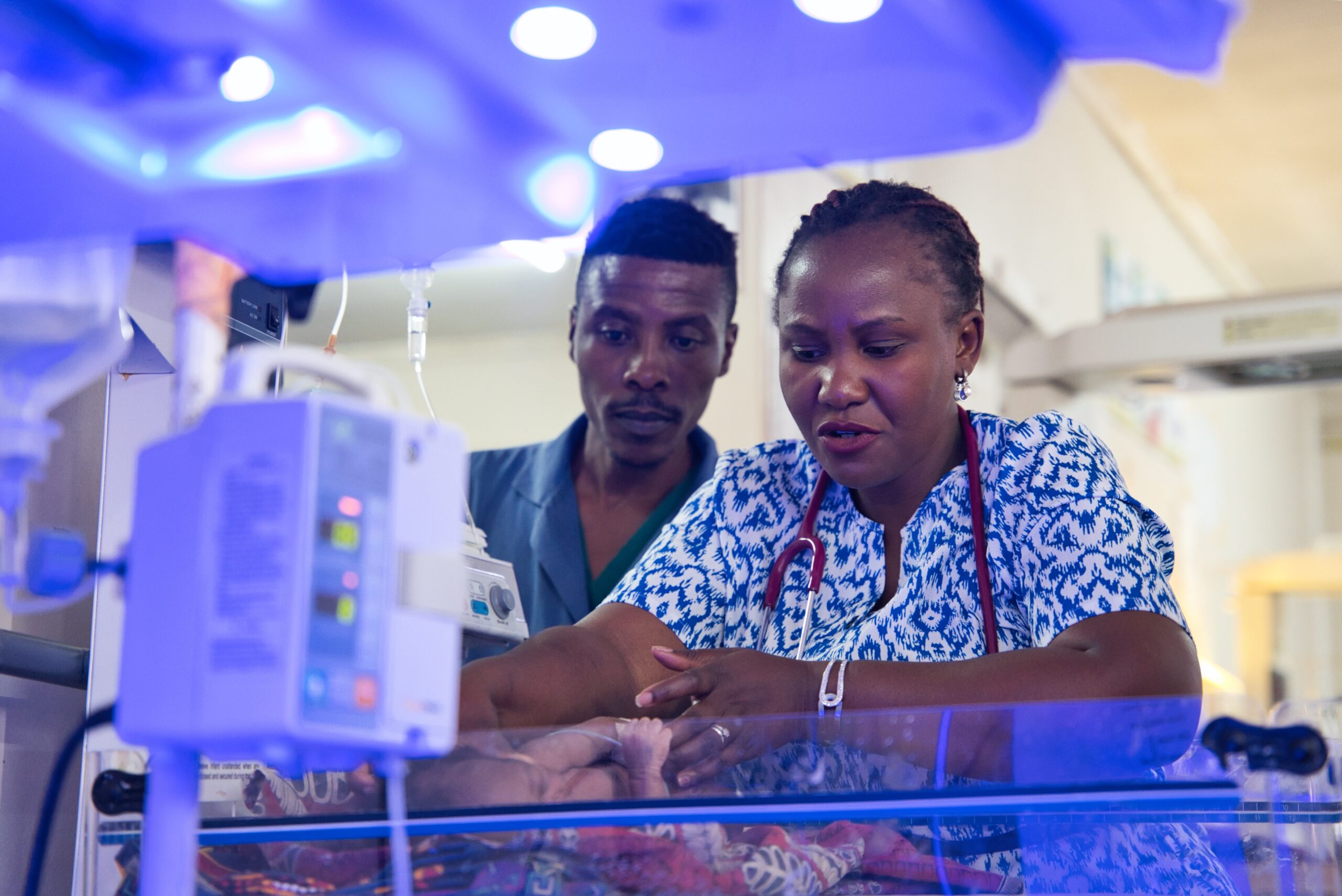
Inside the nursery, monitors beep beside incubators and radiant warmers. Nurses move quickly between babies needing constant attention while parents stand nearby, hoping each check-up brings their child a step closer to going home.

For many newborns admitted to this unit, the first days of life are the most fragile. The unit also serves as a training ground for the workforce that will lead the future of newborn care: Medical students, nurses, and paediatric residents are training here every day, learning the critical clinical skills they will carry into hospitals across the country.
Dr. Douna Granga Daouya, a paediatrician and neonatologist who recently joined Seed Global Health as a physician educator, is now mentoring medical students and in-service health workers who care for the babies in this unit. His presence is an important milestone, not only for QECH and Kamuzu University of Health Sciences, where he now teaches, but also for Malawi’s health system. Dr. Douna is only the second neonatologist in the country.
“I strongly believe that lasting change happens when healthcare professionals have the knowledge, skills, and leadership needed to translate policies into quality care at the bedside,” he said.
Having worked in West Africa supporting maternal, newborn, and child health programs, Dr. Douna now hopes to help build the next generation of clinicians in Malawi who will strengthen newborn care for generations to come.
Despite Malawi making significant progress in reducing maternal and newborn deaths over the past two decades, the number of newborns who die before reaching one month of age is still sobering. The national neonatal mortality rate is 24 deaths per 1,000 live births, which is double the global target of 12. However, the institutional neonatal mortality rate at QECH is even higher, standing at 52 deaths per 1,000 live births.

Reducing those numbers requires skilled health workers who have the expertise to care for newborns with complex medical needs.
QECH, which serves as a referral centre for 29 public primary health centers and eight secondary level facilities, faces a shortage of newborn specialists.
“The nursery unit is often overcrowded, with as many as three babies sharing a radiant warmer instead of one,” explained Dr. Gari, a paediatrician at QECH and aspiring neonatologist.
“Additionally, you’ll find about three nurses caring for 68 babies in the nursery. Those same nurses are also responsible for another 15 to 20 stable babies in the postnatal ward, providing daily reviews and monitoring their vital signs.”
Combined with shortages of essential medical supplies, these challenges make it even harder for the dedicated health workers to provide the level of specialized care that critically ill newborns need. Recognizing these challenges, Malawi’s Ministry of Health identified a need for greater neonatal expertise. Recently, Dr. Douna delivered his first lecture to fifth-year medical students on paediatric HIV and the prevention of mother-to-child transmission.
“As future doctors, these students will play a critical role in ensuring that children are born free of HIV, congenital syphilis, and hepatitis B, and that those living with HIV receive timely diagnosis, treatment, and lifelong care,” he said.
For Dr. Douna, that class represented much more than the start of a new teaching journey. “That experience reinforced why I’m now part of Seed’s mission, to build the next generation of highly skilled health workers who not only provide quality care at the bedside but also teach others. As more clinicians become educators, access to quality newborn care expands.”

This ripple effect is key to building a resilient health system in Malawi. When today’s students become tomorrow’s specialists, educators, and clinical leaders, they multiply knowledge across hospitals, districts, and communities, ensuring more families have access to quality care close to home.
For Dr. Gari, having another neonatologist on the team brings opportunities that go beyond clinical care. “We are optimistic about improving our teaching skills by learning from someone with more experience,” she said.
“We also hope to get guidance on how to transition from a Level 2 to a Level 3 neonatal unit which would allow us to offer advanced newborn care, including ventilation, invasive monitoring, and specialized therapies.”
Patricia Siyabu, principal nursing officer at the neonatal unit, believes Dr. Douna’s presence will strengthen both the workforce and the quality of care provided to newborns.
“Dr. Douna will help reduce the workload for the only neonatologist currently available in Malawi,” she said. “As a unit, we are planning to introduce online teaching sessions for referring facilities. The aim is to reduce unnecessary referrals, decongest our ward, and improve both pre-referral and post-referral care. His involvement will ease the burden on our team as we develop this program.”
For Dr. Douna, these challenges represent opportunities to learn alongside his colleagues while strengthening newborn care. “Over the next 12 months, I hope to see continued progress in newborn intensive care services, stronger competencies among healthcare providers, and wider adoption of evidence-based practices for managing preterm and critically ill newborns,” he said.
He is also looking forward to helping develop a Bachelor of Science in neonatology curriculum for clinical officers, an important step toward building a specialized newborn care workforce equipped to meet Malawi’s growing needs.
For Seed Global Health, this reflects a long-term approach to working with our partners to strengthen health systems.
A resilient health system is built not only through infrastructure or medical equipment, but by investing in people. Every student trained becomes another skilled health worker and they go on to mentor others, creating a cycle of learning that continues long after one educator has left the classroom or ward.
Each student mentored and each doctor trained brings Malawi one step closer to a future where more babies survive, more families thrive, and every child born with complications has a better chance at life.