Dr. Vanessa Kerry’s Opening Remarks at Health Resilience: The Next Era of Global Health at UNGA81
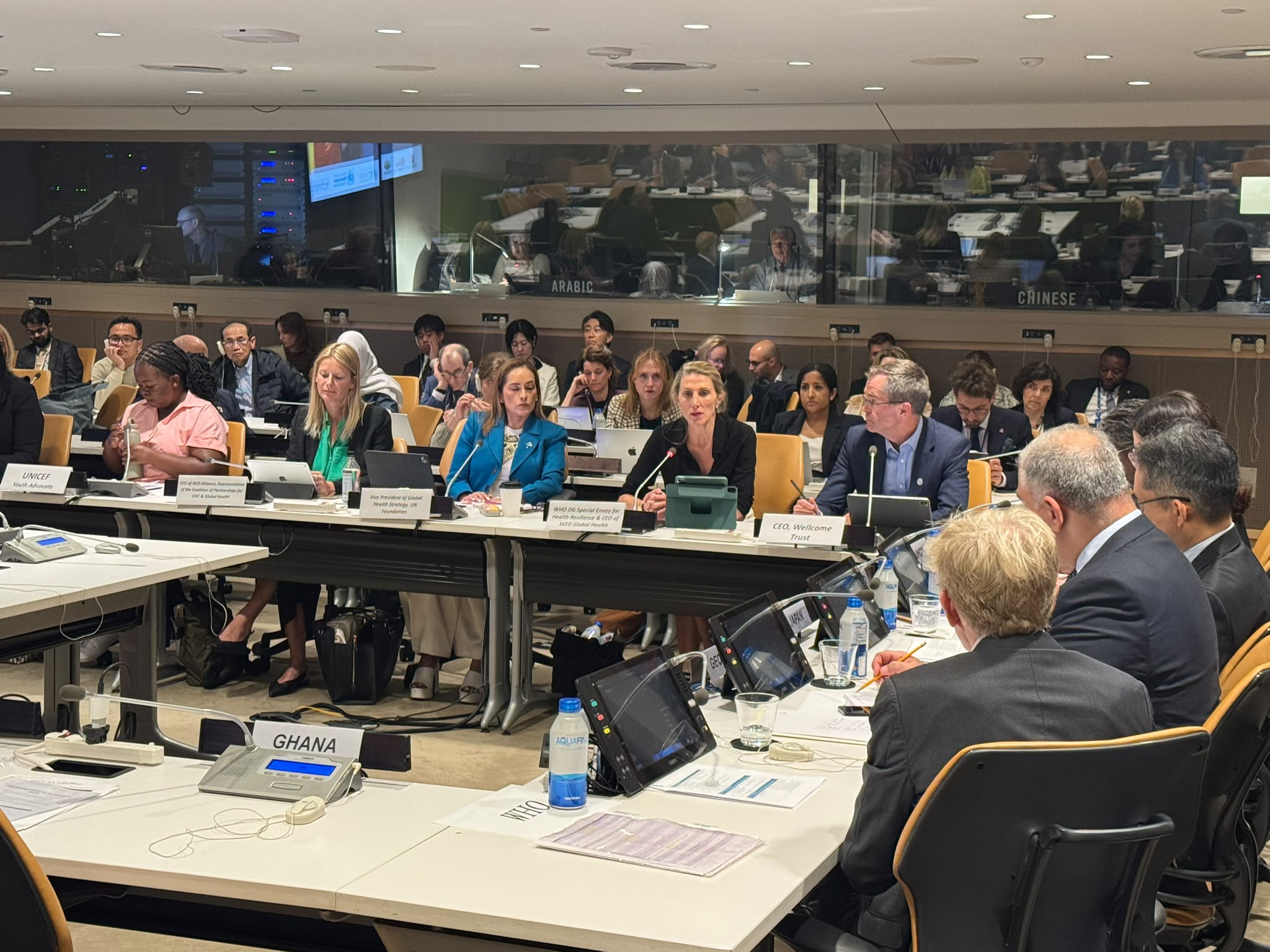
Our CEO delivered a powerful call to action on the way forward for global health reform at a Seed Global Health and The Rockefeller Foundation event at UNGA81
Dr. Vanessa Kerry
September 21, 2026
REMARKS AS DELIVERED
Your excellencies and distinguished guests,
It’s an honor to be with you today, and I really want to thank The Rockefeller Foundation for co-hosting this very important and timely event.
I want to start by posing a question.
Have countries around the world, built health systems strong enough to deliver care every day and to survive when an emergency hits?
Today, the answer is no.
So, as we rethink the future of global health, that should be the critical question that is guiding all of us. It is why we are here in this room today.
Health systems everywhere are under growing strain from rising day-to-day demands to the shocks of climate change, outbreaks, conflict.
And at the same moment, resources for health are shrinking, with foreign assistance falling by up to 60 percentfrom 2022 levels.
And over the past several decades, governments, global health initiatives, philanthropies, and development partners did do something remarkable, mobilizing billions of dollars to fight disease and respond to crises.
We fought malaria. We dramatically reduced HIV transmission. Millions of lives have been saved.
But when politics shifted and funding declined, we discovered something important too often, those billions had not built the durable foundations underneath.
Not the health workers,
Not the infrastructure,
Not the supply chains,
and not the institutions.
All of those that enable health systems to deliver care every day and continue delivering when emergencies strike.
That missing foundation is health resilience.
And it should become the organizing ambition for all of us in the next era of global health.
Because health resilience is how we achieve universal health coverage. It’s how we prepare for the next pandemic. It’s how we adapt to the challenges of climate change.
This has been the mission of our work at Seed Global Health, and I am deeply honored to have been appointed by Director-General Dr. Tedros as the WHO’s Special Envoy for Health Resilience to move this agenda forward at greater speed.
We will never make progress unless we have an honest conversation about financing.
External funding is contracting sharply. Countries are being asked to do more with less.
And no country wants to depend indefinitely on financing from another. Many governments are calling for greater control over their own priorities, and at the same time are also raising funds, increasing domestic funding for health.
We all knew that development assistance was never meant to create permanent dependence. It emergedthough in response to a fundamental gap between countries’ ability to finance and deliver health services to their own people.
If health sovereignty is our goal, development assistance should ultimately help close that gap.
But we are not there yet.
And we find ourselves with a mismatch between the ambition for country ownership and today’s financing reality. In the near term, many countries are going continue to need external financing as they mobilize more domestic resources to pay for health.
And a failure to step up our investment to ensure this transition is going to keep us locked in the same cycle just perpetuating the status quo.
But there is an even harder question that we have to ask.
Is the way we finance health actually producing the outcomes countries want?
For too long, funding has followed donor priorities.
Their projects, their timelines, and their reporting requirements.
Countries have been left to manage and coordinate dozens of separate donors and parallel programs.
And the result has been fragmentation, duplication, and persistent gaps. Weak health systems that are unableto manage today’s challenges, let alone those of tomorrow.
In this new era of global health, our financing architecture must change and its north star must be resilient health systems.
The reality is here a health resilience system cannot be purchased disease by disease or crisis by crisis.
Health resilience is built across an entire system as a whole, over time, through investments in people, infrastructure, supply chains, data, and institutions.
And that requires financing that is predictable, flexible, and sustainable.
Multi-year funding that countries can plan against, aligned with national planning and budget cycles, and with the flexibility to reprogram resources as priorities and circumstances change.
Every country already has a national health strategy. Countries know where their systems are weakest – where there aren’t enough skilled health workers, or medicines fail to reach communities, and which populations are most vulnerable to emerging threats or everyday threats.
Countries build health systems.
Partners should strengthen them, not fragment them.
And that must be the starting point for global health investment.
And putting countries in the lead does not mean writing a blank check. Accountability and results matter. Country leadership and accountability are not opposites.
And the principle is simple. One Plan. One Budget. One Report.
What that means:
One Plan: governments set national priorities.
One Budget: not so governments necessarily control every dollar, but so they can see all the resources available and direct them toward the priorities in their national plans.
One Report: all partners report against and are accountable to the same nationally defined results.
We are already seeing countries move in this direction.
In Uganda, the government is working to bring partner financing into alignment with its national priorities while improving visibility over external resources and remaining gaps.
Rwanda has told their donors money must back the national plan – or stay abroad. Ethiopia has built an architecture that gives partners a practical route to align – rather than each creating its own parallel financing and accountability track.
No approach is finished or perfect; I think we can all say that, but each points the way to a different model: where countries set the direction, partners align behind it, and financing strengthens national systems rather than creates parallel ones.
But the financing challenge is bigger than domestic budgets alone can solve. Countries can only close the financing gap so far on their own. Many are increasing domestic investment in health.
But today, more than half of African countries spend more on debt interest than on health.
So, reform cannot simply mean that countries spend more. It must also mean that changing the financial conditions and fiscal space, it means we have to change financial conditions and the fiscal space, so that money can be spent more efficiently and more effectively.
Ultimately, we need to redefine how progress is going to be measured.
And this should be a test for the reform agenda as a whole.
Not simply how many programs we’ve delivered. Or how many children have been vaccinated.
While important, those achievements do really, really matter. But on their own, they do not tell us whether health systems are becoming stronger.
Instead, we need to ask:
Can a mother in labor reach a skilled midwife?
Can a clinic keep essential medicines in stock?
Can essential services continue when an emergency hits?
And when that emergency is over, critically, is the health system better prepared for the next one?
If reform leaves countries with more fragmented financing, more parallel systems, and more short-term programs, then no matter how elegant the new architecture looks on paper or on stage, we will have missed this moment.
We will be abdicating our collective responsibility and position to finally fix a broken system that we have been inadequately patching and is undeniably failing millions of people around the world. Truly, we have a moment right now, that we all have the privilege and the opportunity to do something about, the pressure, but we need to actually take that action forward.
This is the opportunity of global health reform.
Not to simply to reorganize institutions or change who pays for what. But to agree on what the global health system is actually for.
Our guiding principle must be to support countries to build health systems that deliver high-quality care every day and continue delivering when the shocks hit.
Whether it is climate, whether it is Ebola, whether it is funding falling off the cliff tomorrow.
The same health workers, the institutions, supply chains, and systems that protect us during the next pandemic are the ones giving caring every day, today.
The model built a generation ago with donors in distant capitals deciding what a country needs, and resources flowing through fragmented programs, which we are sort of perpetuating right now with our discussions today, cannot meet the challenges for the world we live in now or frankly the aspirations we all share or we wouldn’t be sitting in this room.
We need to be ambitious about what reform can achieve.
It’s a world where every country can provide high-quality care, every day.
A world where health systems do not crumble in the face of outbreaks or shocks.
A world where everyone, no matter where they are born, survives and thrives.
So, as we shape the next era of global health, I am asking everyone in this room to make health resilience the test of this moment.
Because in the end the choice is simple.
We can keep paying for one crisis at a time, at ever greater cost.
Or we can prioritize, invest, and build in the resilient health systems that create a safer, more stable and more prosperous world.
The choice starts now.
Thank you.